


How to find a graphic design internship – Top 10 tips
Design advice - Simon

How to find a graphic design internship – Top 10 tips
Design advice - Simon
29th June 2016
Finding an internship is very similar to finding a full-time job and should be approached in a similar way. It probably won’t be easy but don’t give up!
I receive emails and applications for internships from lots of student designers, and in my opinion only a very few go about things in the best way, and most people do what everyone else does, rather than ‘thinking differently’.
These are my top 10 tips. I don’t promise everyone will agree but hopefully some of these ideas will help.
1. Research carefully
Make a list of the design agencies/businesses that appeal to you, and find out as much as you can about them. “Who are the decision makers?” “What can I find out about those people?” You may find you have something in common that will appeal to them. Perhaps you went to the same school, or enjoy the same sports, or like the same music.
2. Ask for advice from older students
If you are not sure which companies to approach, try asking students in the year above you where they did their work placements or internships. They may well be able to tell you who to speak to or even put in a good word for you. The chances are that if a company have taken on students one year they will do the same again the following year.
3. Plan early and get your applications in before everyone else
You might even consider approaching a designer you respect and say to them “would you mentor me”, or “would you mind looking at my portfolio and advising me how I can improve my chances of getting a placement or internship”. Doing this appeals to a designer’s ego! That person may not offer you what you are looking for, but they may be flattered to have been asked and they will know lots of other people in the industry who might be able to help.
4. CV
I think it is easy to ‘over-design’ a CV. My personal opinion is that it should look like a CV. Beautiful, clean typography, not what you might consider ‘creative’ typography. Less is more!
• Save as a .pdf Why send a Word doc to a design company?
• Call it something logical Simon_Mercer_CV.pdf, not, CV.version8iv.pdf
• Check it. Get someone else to check it. Check it again. Read it backwards!
• If you are doing it in a foreign language, you must get a native speaker to read it.
• Start strongly, finish strongly. A conclusion as to why people should take you on is a good idea.
• If you include links in your CV to your portfolio of work, or website, make sure that the links are clickable from the pdf.

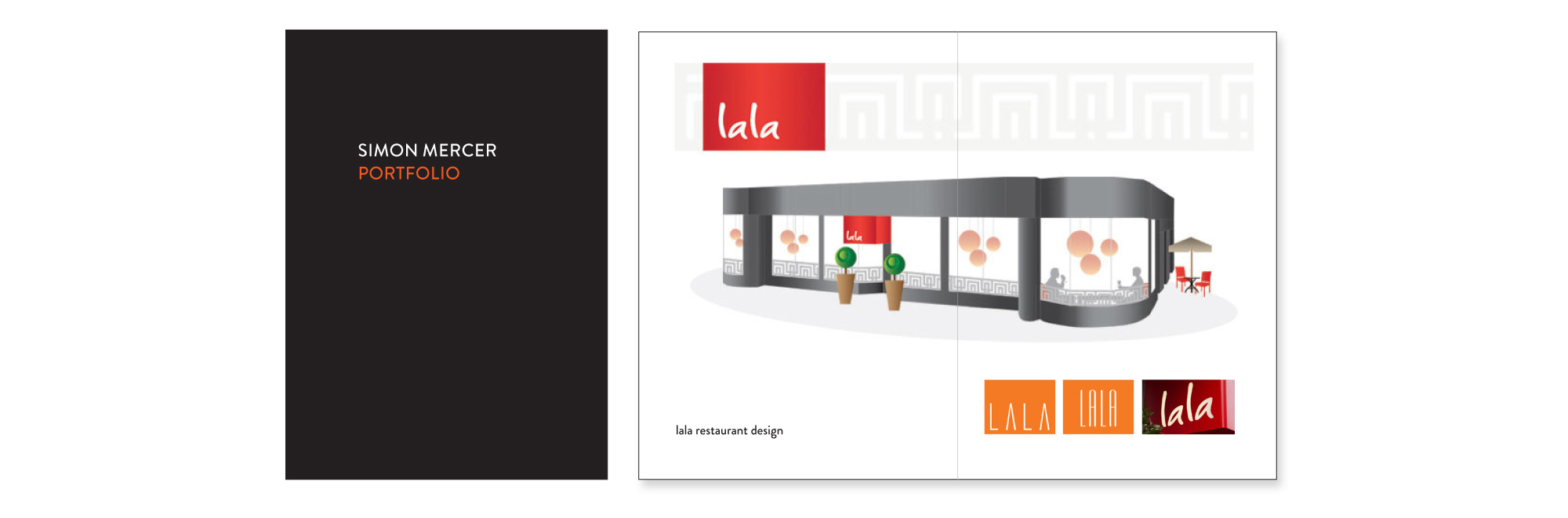
5. PDF portfolio
Call it something logical to match CV: Simon_Mercer_Portfolio.pdf
• Don’t ‘overdesign’. Let your work do the talking. Use a simple grid to align items across pages.
• Get someone else to check your spelling. Check it again. Read it backwards.
• Make it a manageable size, both in terms of number of pages and file size. NOT TOO BIG. NOT TOO SMALL. Perhaps 10 pages, 5mb. Learn how to optimise the output from Indesign/Acrobat to obtain an optimum balance between quality and file size.
6. Website
A website is a great way of showcasing your work, and also demonstrates to a company that you are comfortable with digital technologies.
Keep the navigation simple! Prospective companies will spend 5 minutes on it at the most, so they don’t want to spend the first 2 minutes trying to understand how the navigation works.
• Don’t overdesign. Allow it to showcase your work
• ‘Pictures speak a thousand words’. Perhaps include the briefest of explanations about your work, but nothing more.
• Choose a theme that suits your skills: Illustrator, Photography, Video/animation, Graphic design.
• If your work is in video or animation then it would make sense to have a link where people can view your showreel.

7. Be meticulous in your addressing
Be very careful when you are sending out emails or letters. I have lost count of the number of emails I have received that haven’t even been addressed to the correct person.
‘Dear Steven...’ Not a good start if my name is Simon! You are wasting your own time as well as other people’s.
8. Don’t be a sheep... ‘think differently’
A typical approach is to send an email with a CV and a PDF attached, but perhaps consider if this is the best way of doing things? Is it polite to bombard someone you don’t know with attachments of various sizes? How about emailing or calling someone first and saying something like... “ I’m a multi-talented and ambitious designer, keen to learn from the best designers in the business... Would you be interested in seeing some samples of my work?”
I’m not saying that will guarantee success but I'm suggesting you think of different approaches. If you send out 250 letters or emails and get no positive responses, perhaps you are doing something wrong?! Change your approach!
9. Be persistent. But not too persistent!
Sometimes getting a positive response is luck. You happened to email someone when they were in a good mood, or perhaps they had a bit of free time when you made your phone call. Decision-makers tend to be busy people, and you need to catch them at a good time. That is why it might be best to ask people first before sending them your email/cv/work examples.
10. Say ‘Thank you’.
Even if you get a negative response from someone, say ‘Thank you for taking the time to consider me...’ You never know where politeness and good manners might lead to!